


The latest thought leadership, news, events, and more from Woolpert Digital Innovations
From Production Planning to the Plant Floor: What an Agentic Manufacturing Operation Looks Like
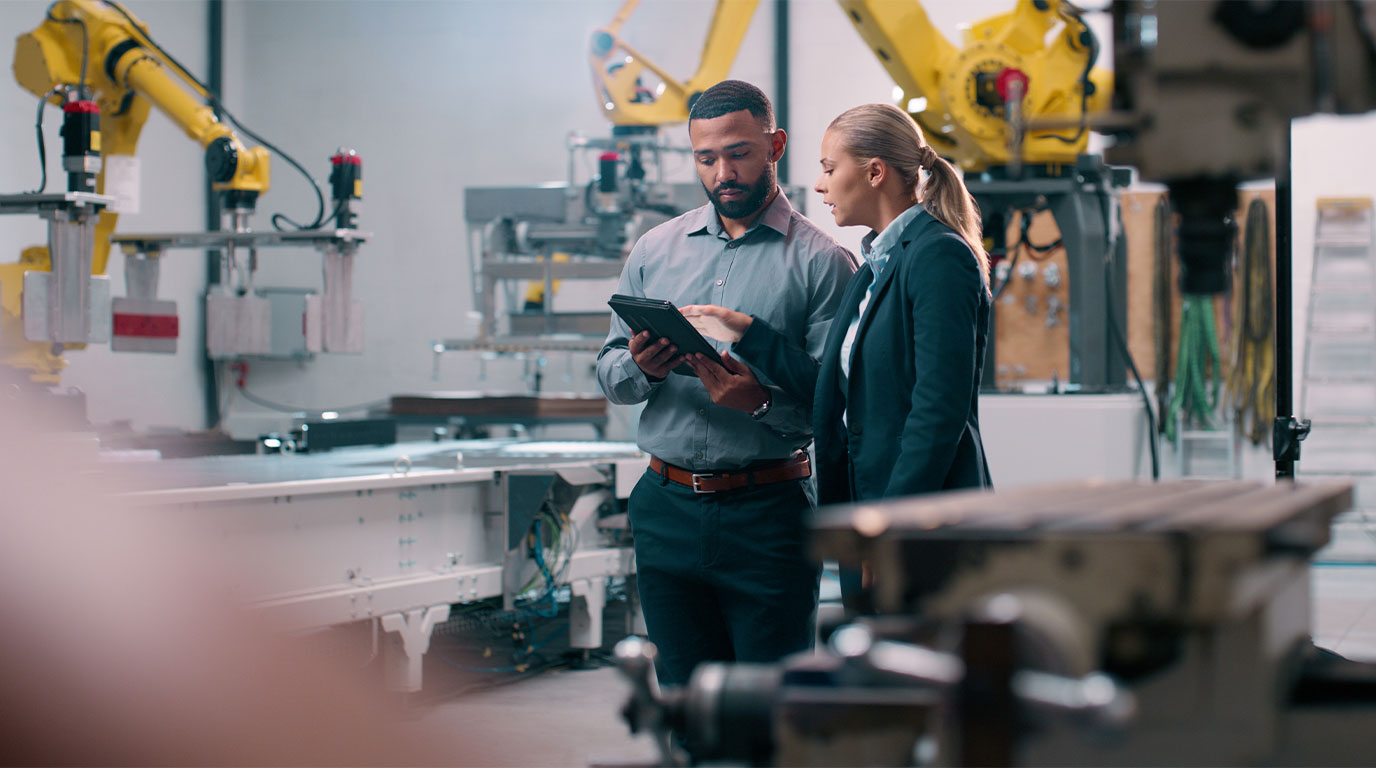
Manufacturers have spent decades automating production. Robotics perform repetitive tasks with remarkable precision. Manufacturing execution systems track what is happening on the plant floor. Enterprise resource planning systems manage orders, inventory and materials, while increasingly sophisticated sensors provide real-time information about equipment performance.
Yet even in highly automated facilities, a surprising amount of work still depends on people connecting the dots.
A production planner learns that a critical material shipment will arrive late and adjusts the schedule. A maintenance manager discovers that equipment downtime will affect production targets and alerts operations. A quality issue requires employees to determine which production runs, inventory and customer orders may be affected. A change on the plant floor forces logistics teams to reconsider dock schedules and outbound transportation.
Manufacturers have become increasingly effective at automating individual processes. The next opportunity is coordinating everything that happens around those processes.
That is where the agentic workplace could have its greatest impact on manufacturing.
The Plant Floor Doesn’t Operate in Isolation
A manufacturing facility may look like a contained operation, but almost every production decision depends on conditions elsewhere in the business. Customer demand influences the production plan. The production plan depends on materials, labor and equipment availability. Finished products require warehouse capacity and transportation, while disruptions anywhere in that chain can force plans to change.
The challenge is that the systems managing those activities often operate independently. ERP software may contain customer orders and material requirements, while an MES tracks production and a computerized maintenance management system manages equipment. Warehouse and transportation systems handle another part of the operation, and supplier information may reside somewhere else entirely.
When everything goes according to plan, those systems can work extremely well. The coordination problem becomes more visible when something changes.
Suppose a critical piece of equipment unexpectedly goes offline. Maintenance needs to diagnose the problem and determine how long repairs could take, but operations also needs to know which production orders are affected. Planning may need to resequence work, procurement may need to check materials, warehouse teams may need to adjust expected volumes, and logistics may have to move carrier appointments.
The machine failure happened in one place. The consequences did not.
Agentic AI Can Help Connect Events to Their Operational Impact
Many manufacturers already use automation, analytics and artificial intelligence to detect problems. Predictive maintenance provides a good example. Equipment data can indicate that a component is behaving abnormally or may be approaching failure, giving maintenance teams an opportunity to intervene before an unplanned shutdown.
Agentic AI extends that idea by asking what should happen next.
Instead of simply generating an equipment alert, an agentic workflow could evaluate the production orders scheduled for that machine, determine whether another line has available capacity, check whether resequencing would create material constraints, identify customer orders that could be affected and recommend a response to the production planner. If the schedule changes, downstream warehouse and transportation workflows could also receive updated information.
The difference is important. Detecting a problem provides visibility. Connecting that problem to its operational consequences helps the organization respond.
For manufacturers evaluating agentic AI, this provides a useful way to identify potential applications. Look beyond processes where AI can generate another prediction, alert or dashboard. Look for situations where an event consistently forces people to gather information from multiple systems before they can decide what to do.
Production Scheduling Can Become More Dynamic
Production planning is an obvious place to look because manufacturing schedules depend on variables that rarely remain static. Customer priorities change, materials arrive late, employees call off, equipment becomes unavailable and production runs take longer than expected.
Traditional planning systems can account for many of those constraints, but planners frequently become responsible for reconciling changes once the schedule encounters reality. They may need to check inventory, contact procurement, review equipment availability, communicate with supervisors and determine whether outbound transportation can accommodate a revised completion time.
An agentic workflow could help perform that coordination continuously. When an input changes, agents could gather the relevant operational context, evaluate downstream impacts and present planners with updated options. A planner might see that moving one production run solves a material shortage but creates a conflict with a customer priority, while another option keeps the order on schedule but requires a transportation change.
The objective is not necessarily autonomous scheduling. It is giving experienced planners better options faster, with the consequences of those options already evaluated across connected parts of the operation.
Maintenance Decisions Become Production Decisions
Manufacturers have invested heavily in predictive and preventive maintenance because unplanned downtime is expensive. Agentic systems could make maintenance information more valuable by connecting equipment health directly to production priorities.
Consider a condition-monitoring system that identifies abnormal vibration on a critical machine. A traditional system may create an alert or maintenance ticket. An agentic workflow could go further by determining when the machine is scheduled to run, which orders depend on it, whether maintenance can be performed during an existing changeover, whether replacement parts are available and what production capacity exists elsewhere.
That additional context changes the decision. The question is no longer simply, “Does this machine need maintenance?” It becomes, “When should we perform the maintenance, and how can we minimize the operational impact?”
This is a good example of where human oversight remains critical. Maintenance and operations leaders still determine the appropriate course of action, particularly when safety, quality or significant production commitments are involved. Agentic AI can reduce the manual work required to understand the situation before those leaders make the decision.
Materials Problems Shouldn’t Be Discovered at the Production Line
Material availability creates another opportunity. Manufacturers often manage large supplier networks, multiple inventory locations and thousands of individual components, making it difficult to understand how a supplier disruption will affect production until planners investigate.
An agentic workflow could continuously connect supplier information with inventory, production requirements and transportation status. If an inbound shipment is delayed, the system could determine which production orders depend on those materials, check available inventory at other locations, evaluate whether production can be resequenced and identify alternative sourcing options where appropriate.
The earlier that analysis occurs, the more options the manufacturer has. A problem identified several days before a production run may be manageable through a schedule adjustment or inventory transfer. The same problem discovered when a line is waiting for material can become an expensive interruption.
For leaders looking for an initial agentic use case, these recurring material exceptions are worth examining. They tend to involve high-frequency decisions, information distributed across multiple systems and clearly measurable outcomes such as downtime, schedule adherence, expedited freight and on-time delivery.
Quality Events Need Faster Cross-Functional Responses
Quality issues illustrate why coordination matters just as much as detection. When a defect or process deviation is identified, manufacturers need to understand more than what happened on one production line.
They may need to determine which lots were affected, what raw materials were involved, whether finished inventory has already moved to another facility and whether customer shipments need to be placed on hold. Quality, production, warehouse, supply chain and customer-facing teams can all become part of the response.
Agentic workflows could help assemble that operational picture faster. Relevant production records, inventory information, supplier data and shipment status could be connected so employees can understand the potential scope of an issue without manually searching multiple systems.
This is also an area where governance becomes especially important. Organizations need clearly defined decision rights governing which actions an agent can perform, which recommendations require human approval and when an issue must be escalated. A useful agentic system should make those boundaries explicit rather than treating autonomy as the objective.
Production Changes Need to Reach Logistics Faster
The connection between manufacturing and logistics may offer one of the clearest examples of the value of an agentic workplace.
Transportation plans are built around expectations about when products will be ready. A production delay can therefore affect dock appointments, trailer availability, carrier schedules, distribution center operations and ultimately customer delivery commitments. Yet logistics teams may not learn about a production problem until a scheduled shipment is already at risk.
Agentic workflows create an opportunity to connect those environments more closely. If production completion moves by several hours, an agent could evaluate the transportation implications, determine which loads are affected and identify available alternatives. Depending on the organization’s rules, it could recommend changing an appointment, evaluating another carrier or updating an estimated delivery time.
Location intelligence adds another layer of context. Traffic, weather, route constraints, facility locations and real-time transportation conditions can all influence whether a proposed logistics response will actually work. Combining those signals with production and enterprise data allows decisions to reflect what is happening both inside the facility and across the physical network surrounding it.
That connection matters because production performance should not end at the loading dock. Manufacturers ultimately need to fulfill a customer commitment, and the systems supporting production and transportation should be able to respond to changes as part of the same operational workflow.
Start with the Decisions People Have to Reconstruct Every Day
Building an agentic manufacturing operation does not require connecting every plant, platform and workflow at once. A better starting point is identifying situations where experienced employees repeatedly reconstruct the same operational picture before making a decision.
Look for production meetings where teams manually assemble information from several systems. Examine exception reports that routinely require follow-up calls or emails. Ask planners which disruptions force them to open the most applications, contact the most people or spend the most time determining downstream impacts.
Then narrow the opportunity further. A strong initial use case should have a clearly defined business outcome, accessible data and enough frequency to demonstrate measurable value. Schedule adherence, downtime, mean time to repair, inventory shortages, expedited freight, on-time delivery and time spent resolving exceptions can all provide useful measures depending on the workflow.
The first project does not need to prove that an entire factory can operate autonomously. It needs to demonstrate that one important workflow can operate with less friction.
Manufacturing’s Next Automation Opportunity Is Coordination
Automation will continue to transform what happens on the plant floor. Machines will become more intelligent, sensors will produce more information, and AI will improve manufacturers’ ability to forecast demand, identify defects and predict equipment failures.
But those advances create another challenge. More information does not automatically create better operations. Someone, or something, still has to connect what is happening in one part of the organization with what needs to happen next.
That is the larger opportunity behind the agentic workplace. Manufacturers can begin connecting planning, materials, production, maintenance, quality and logistics so operational events trigger coordinated responses rather than a new round of manual investigation.
Manufacturers have spent decades making individual processes faster and more efficient. The next productivity gains may come from reducing the time, effort and uncertainty required to coordinate everything between them.