


The latest thought leadership, news, events, and more from Woolpert Digital Innovations
Top 10 Trends Shaping AI, Cloud, and Data Strategy in 2026

EXECUTIVE SUMMARY
After several years of digital experimentation, leading organizations are no longer debating whether to adopt AI, modernize their data estate, or commit to cloud-native architectures. Those questions have been settled. The real conversation now centers on how quickly businesses can adapt their operating models, how consistently they can govern information, and how effectively they can deploy automation without introducing operational risk.
The stakes are high. Growth markets are shifting toward companies that can turn data into decisions in real time. Workflows built around manual retrieval and repetitive review no longer keep up with customer expectations or regulatory demands. Security teams face increasingly complex threats. Finance leaders want predictable cloud consumption. Business units want tools that reduce time spent on low-value tasks. Boards want measurable results from AI investments.
In this environment, leaders need a clear view of where the industry is heading and which investments will matter most over the next 12 to 24 months.
What worked in 2024 and 2025 — isolated pilots, incremental upgrades, and tactical deployments — will not be enough in 2026.
The organizations outperforming their peers are the ones treating AI, data, and cloud modernization as a connected strategy rather than a collection of projects. This paper outlines the 10 trends shaping that strategy.
These trends come directly from what we see inside enterprise programs: the pressures they face, the architecture patterns they adopt, the obstacles they encounter, and the opportunities that arise when they pair disciplined data governance with well-designed automation.
Each trend reflects a deeper shift. AI is no longer viewed as a single capability but as a foundational layer that influences workflow design, cost governance, data management, security posture, and application architecture. Cloud is no longer defined by where systems run, but by how those systems scale, integrate, and respond to real-time events. Data is no longer seen merely as a reporting asset, but as core infrastructure for operations, automation, and product innovation.
The times are changing, and fast.
2026 will reward the organizations that make deliberate choices: consolidating systems instead of multiplying them, tightening governance instead of relaxing it, investing in reusable patterns instead of one-off experiments, and building trust frameworks that let automation scale safely.
The following sections break down what leaders should expect as AI, cloud, and data strategy converge into a unified operating model for the modern enterprise.
1. AI-NATIVE WORKFLOWS BECOME THE OPERATIONAL BASELINE
The most advanced organizations no longer treat AI as a feature bolted onto legacy processes. They are rebuilding core workflows so that automation handles the initial pass, humans provide oversight, and the system continuously improves as usage grows.
This shift changes expectations for speed and accuracy. Case work begins with a ready-made brief, not an empty form. Operational issues surface through automated summaries before anyone checks a dashboard. HR and finance tasks move forward with pre-filled context and clear recommended actions.
Google Cloud’s Gemini models, BigQuery-based retrieval, and managed orchestration make this redesign practical. The question for leaders is no longer, “Where can we add AI?” but rather, “Which workflows should be rebuilt around it?”
KEY SIGNALS OF THIS TREND
- AI-generated first drafts become standard in daily operations.
- Cycle times drop because teams spend less time gathering context.
- Rework decreases due to more consistent upstream inputs.
2. ENTERPRISE AGENTS MATURE INTO INSTITUTIONAL PLATFORMS
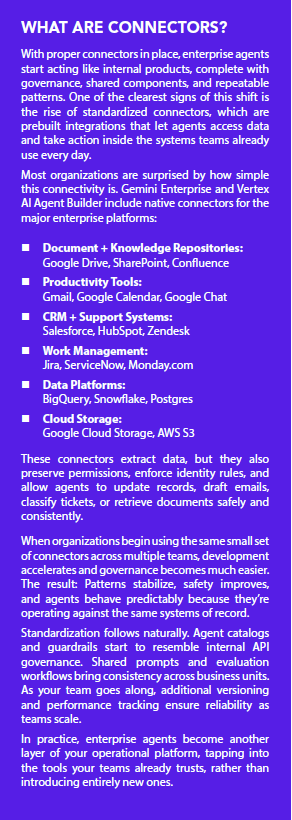
After a year of pilots, many organizations now understand that standalone agents create fragmented risk and unpredictable outcomes. In 2026, companies are building centralized agent platforms with shared connectors, evaluation pipelines, action libraries, prompt templates, and governance policies.
 This move transforms automation from experimentation into infrastructure. Teams can develop new agents without renegotiating access or rebuilding core steps. IT gains visibility into how decisions are made. Business units gain faster, safer deployment paths.
Google Cloud’s Gemini Agent Builder formalizes these patterns and gives enterprises a stable foundation for multi-agent environments.
KEY SIGNALS OF THIS TREND
- Organizations begin managing agents with the same structure and discipline they apply to API governance, such as central catalogs, clear permissions and defined usage rules.
- Common connectors and shared prompts reduce development time (see sidebar).
- A connector is the bridge that lets an AI agent securely access and work with your business data. In practice, it’s the piece of plumbing that links the agent to systems you already use (for instance, Google Drive, SharePoint, Jira, Salesforce, BigQuery, or a SQL database) so it can read information, search it, or take approved actions.
- Performance, safety, and version control become standardized.
3. DATA QUALITY EARNS EXECUTIVE LEVEL OVERSIGHT
AI cannot outperform the quality of the information feeding it. Boards and executive teams now treat data governance as a strategic requirement, not a support function.
Organizations are investing in lineage tracking, content cleanup, permissions rationalization, sensitive data protection, and semantic standards.
Retrieval layers and vector indexes are curated with far greater discipline. The intent is clear: If data drives decisions, its quality must meet a higher bar.
With BigQuery acting as the analytic backbone and governed storage serving as the retrieval surface, leaders are able to enforce consistent expectations across teams.
KEY SIGNALS OF THIS TREND
- Data stewardship responsibilities are formally assigned.
- Retrieval accuracy improves as corporate material becomes curated and current.
- Audit teams treat data governance the way they treat financial reporting.
4. MODERNIZATION STRATEGIES EMPHASIZE CONSOLIDATION OVER MOVEMENT
Enterprises that rushed to migrate workloads are now facing the cost of too many overlapping systems. Simplicity will become more important moving forward. Modernization in 2026 means consolidation; key areas might include retiring redundant platforms, merging data stores, and establishing unified semantics. This is where it’s important to keep a human at the steering wheel to some extent.
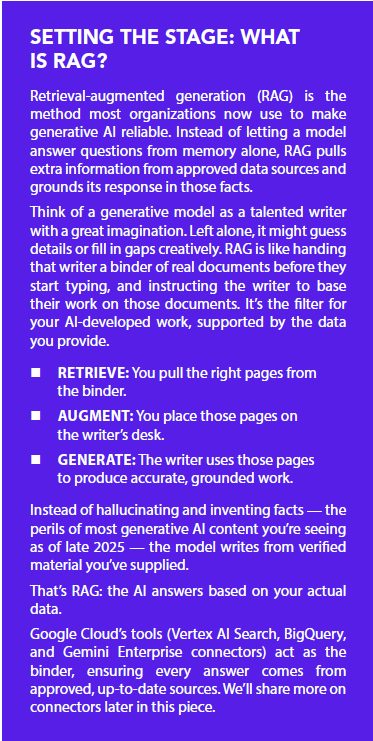
This shift directly improves AI readiness. Consolidated systems reduce inconsistencies, improve retrieval grounding, and streamline your RAG-based data pipelines. The enterprise gains fewer bottlenecks, cleaner schemas, and lower long-term operating costs.
Google Cloud’s BigQuery, Cloud Storage, and Pub/Sub ecosystems give organizations a stable platform on which to rebuild without multiplying complexity.
KEY SIGNALS OF THIS TREND
- Redundant systems and schemas are retired systematically.
- Data clarity improves as silos collapse into unified layers.
- Development teams gain speed because the environment is simpler.
5. SECURITY OPERATIONS ADOPT AUTONOMOUS DEFENSES
Security teams continue to face high alert volumes and constrained staffing. AI-augmented security change s the equation. Modern systems analyze identity behavior, scan configuration drift, detect anomalies across telemetry, and recommend fixes before risk compounds.
Zero Trust principles benefit from this automation. Privilege levels remain tighter, misconfigurations are corrected sooner, and incident response becomes faster and more consistent. This is important because most breaches ultimately exploit basic vulnerabilities and oversights, not exotic attacks. When routine monitoring and enforcement become automated with proper AI tools, security teams can focus on true investigation work instead of chasing routine alerts.
With tools like Chronicle, BeyondCorp, and Google Cloud’s AI-enhanced threat detection, organizations can enforce policies that previously required constant manual effort.
KEY SIGNALS OF THIS TREND
- Misconfigurations are corrected earlier and more consistently.
- Identity behavior is monitored continuously, not periodically.
- Incident response relies less on escalation chains and more on automated insight.
6. FINOPS SHIFTS TOWARD PREDICTIVE ECONOMICS
Cloud cost management is moving from reactive reporting to proactive forecasting. AI-driven FinOps tools model consumption patterns, anticipate workload spikes, provide anomaly alerts, and recommend adjustments before budget pressures surface. Rather than waiting for a monthly invoice to reveal a spike, automation can surface patterns that inform decision-making.
This is particularly relevant for AI workloads, where those inference patterns can fluctuate significantly. Predictive cost governance gives finance and engineering teams a shared view of expected usage, helping organizations avoid overruns while still supporting ambitious automation programs.
Cost control is only one element of proactive forecasting. Teams can go so far as to model the financial impact of new programs, estimate the effect of scaling certain programs — such as agentic tech rollouts — or evaluate the tradeoffs between serverless and GPU-backed architectures, for example.
With an eye on the future and a real-time ability to pivot, finance and engineering can finally share a data-driven perspective on upcoming decisions.
Google Cloud’s native tools will play a major role here. Imagine Looker, BigQuery, and other AI-driven optimization tools supporting real predictive cost governance into daily operations.
KEY SIGNALS OF THIS TREND
- Forecasts drive decision-making instead of monthly reconciliations.
- Rightsizing recommendations are applied continuously.
- AI workloads receive tighter cost oversight without slowing development.
7. INDUSTRY-SPECIFIC MODELS AND RETRIEVAL LAYERS GAIN MOMENTUM
Generic models are no longer sufficient for organizations with specialized terminology, regulatory constraints, or mission-critical processes. Enterprises are building domain aligned retrieval layers and task-specific models that reflect the vocabulary and logic of their industries.
Utilities, healthcare organizations, manufacturers, governments, and financial institutions are adopting this approach to improve accuracy and trust. These systems rely on curated corporate materials, structured metadata, and RAG pipelines grounded in authoritative data.
Google Cloud’s fine-tuning capabilities, vector search, BigQuery, and Vertex AI pipelines are central to this evolution.
KEY SIGNALS OF THIS TREND
- Responses feel specific to the domain, not generic or overly broad.
- Retrieval layers incorporate specialized schemas and metadata.
- Accuracy gains lead directly to higher adoption among regulated teams.
8. PROPRIETARY DATA BECOMES A REVENUE-PRODUCING ASSET
Many organizations now recognize that their internal data carries value far beyond operational reporting. Information drives competitive advantage, which means that data has effectively become a new form of modern gold. It’s a scarce, high-value asset with as-yet-untapped commercial potential for many businesses.
 With better models, stronger governance, and more reliable cloud infrastructure, organizations are beginning to productize what they know. This is the foundation of proper RAG pipeline implementation.
Think about it: Most companies sit on years of logs, transactions, sensor feeds, geospatial layers, customer behavior patterns, and operational benchmarks. Until recently, this information stayed locked inside dashboards, used only by internal teams.
AI is changing that.
Predictive APIs, industry benchmark indexes, risk-scoring services, environmental exposure models, and decision support datasets are becoming viable revenue streams. A logistics company might expose route-efficiency scores to shippers; a manufacturer could publish machine-health predictions; a utility might offer flood-risk datasets tied to historical and real-time telemetry; a financial institution could sell anonymized market trend indicators aggregated from customer behavior.
Turning data into a product requires discipline. Your organization must oversee clean data lineage, stable schemas, strong privacy controls, and dependable delivery. Google Cloud provides the foundation for this shift through BigQuery, Vertex AI, Apigee API management, and built in governance frameworks that support secure, scalable distribution.
For many organizations, the commercial value of their data now rivals or even exceeds its internal operational value.
As more companies formalize “data products” as part of their portfolio, information is emerging as a strategic revenue driver in its own right.
KEY SIGNALS OF THIS TREND
- Data becomes part of product roadmaps, not just BI initiatives.
- External APIs and premium datasets generate measurable revenue.
- Partnerships form around shared data models and benchmarking assets.
9. SERVERLESS AND EVENT-DRIVEN ARCHITECTURES BECOME THE CORE OF AI OPERATIONS
AI workloads expand and contract rapidly. They often behave very differently than traditional digital applications.
Inference traffic spikes unpredictably. Retrieval pipelines run in bursts. Multi-step agent workflows can trigger dozens of downstream actions at once. Serverless architectures are built for this kind of volatility. They scale up instantly when a model call or RAG pipeline surges and scale back down when demand drops, eliminating the cost of idle compute.
Event-driven systems built on Pub/Sub, Eventarc, Cloud Run, and Cloud Functions can give AI agents the responsiveness they need. For example, a new document ingested into storage can trigger immediate vectorization. A geospatial update can launch a recalculation workflow. A user query can fan out to multiple retrieval sources without pre-provisioning infrastructure.
These patterns allow AI systems to process high-volume, compute-heavy workloads with speed while keeping operational overhead low.
For organizations deploying generative models, retrieval pipelines, or automation chains, this serverless infrastructure becomes the backbone that absorbs complexity. It keeps workloads fast, elastic, and cost-efficient, even as demand scales into the (possibly, likely) millions of requests per day.
KEY SIGNALS OF THIS TREND
- Systems scale seamlessly during inference spikes.
- Real-time decisions rely on event streams, not manual polling.
- Cost structures remain predictable because infrastructure adjusts automatically.
10. THE HUMAN–MACHINE BOUNDARY IS REDEFINED THROUGH FORMAL OVERSIGHT
As automation expands, organizations must determine when systems act independently and when human approval is mandatory. This requires a clear, documented approach, often referred to as trust architecture.
Human-in-the-loop (HITL) best practices define the roles of human oversight, escalation rules, audit expectations, review thresholds, and the boundaries of acceptable autonomy. When done well, HITL infrastructure creates predictable, safe environments where automation can scale without creating risk.
KEY SIGNALS OF THIS TREND
- Approval pathways are standardized across departments.
- High-risk actions always include manual verification.
- Audit teams gain transparency into how automated decisions are made.
CONCLUSION
The next phase of digital strategy will not reward organizations that wait for the market to settle. The landscape is moving too quickly, and the competitive gap between early adopters and cautious observers is widening each quarter.
As AI moves into the core of business workflows, data governance becomes foundational infrastructure, and cloud-native systems power real-time decision cycles, leaders must decide whether they will shape these shifts or react to them later at far greater cost.
The trends outlined here point to a common theme: Advantage comes from coherence.
When AI, cloud, and data programs evolve in isolation, they create technical debt and inconsistent user experiences. When they evolve together, they create a unified operating model, one in which information flows cleanly, automation can scale safely, and teams spend more time making decisions than searching for answers.
This shift requires deliberate investments: consolidating legacy systems instead of multiplying them, improving data quality instead of expanding storage, strengthening trust frameworks instead of assuming safety by default, and building reusable agent and automation patterns instead of one-off pilots. It also requires leadership alignment. Board members, security teams, finance departments, and frontline operations must share a consistent view of what responsible modernization looks like and how progress will be measured.
Organizations that succeed in 2026 will be the ones that treat AI as an operating principle, not a project; those who see data as infrastructure, not exhaust; and those who build cloud environments that can absorb new capabilities without constant reinvention.
At Woolpert Digital Innovations, we see these patterns across industries every day. The teams making real progress share a commitment to clarity, operational discipline, and the willingness to rethink long-standing processes in light of new capabilities. These qualities will define the next generation of leaders.
The opportunity is significant. So is the responsibility. But for organizations ready to approach AI, cloud, and data strategy with purpose and coherence, 2026 offers the chance to build systems that are faster, safer, more resilient, and far more capable than anything that came before.