


The latest thought leadership, news, events, and more from Woolpert Digital Innovations
The Real Value of AI is Unlocking Siloed Information
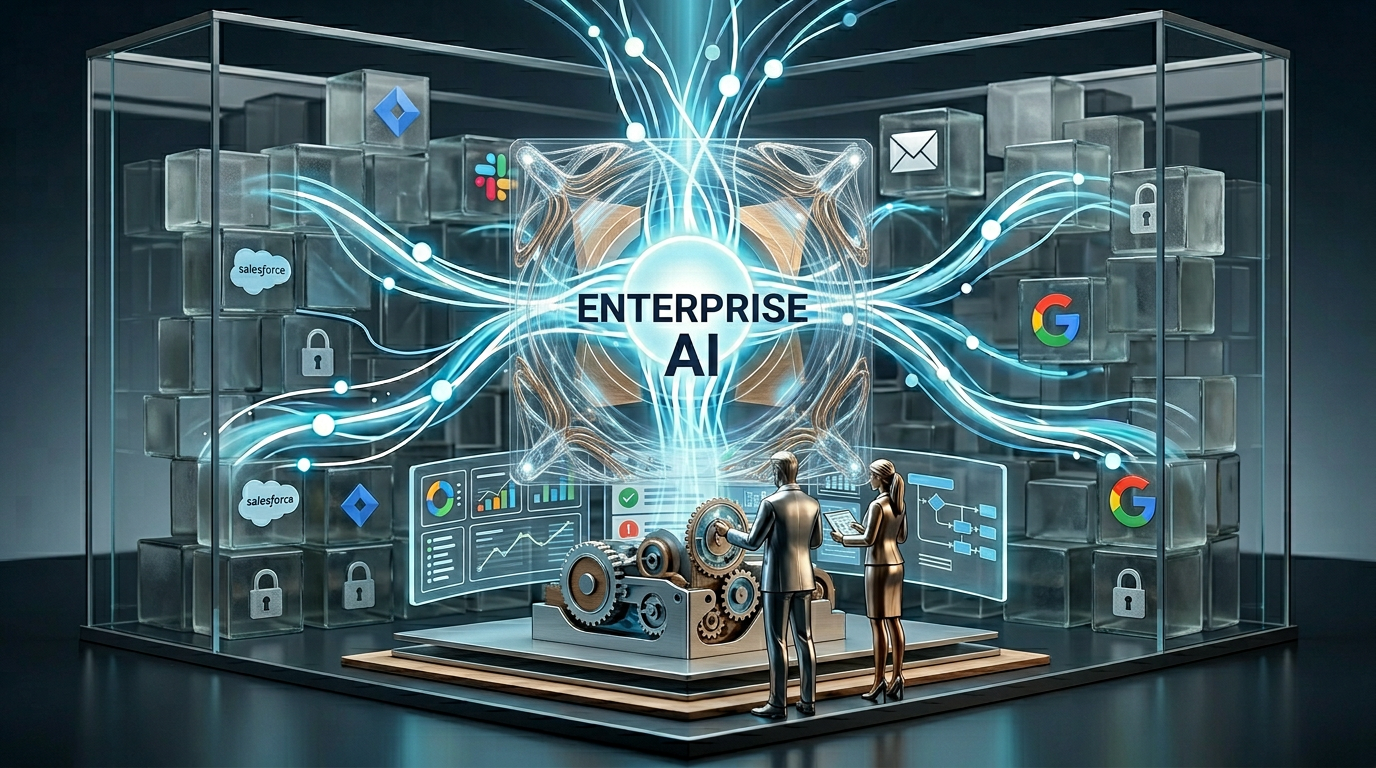
Most organizations have plenty of information at their disposal, but they tend to have a coordination problem.
Critical business data already exists across the enterprise: project updates in Jira, customer activity in Salesforce, conversations in Slack and email, financial records in SQL databases, and documents in cloud storage. Access is not a problem for employees — the issue is fragmentation.
Employees spend a surprising amount of their day moving between systems to gather context before they can actually act. A project manager checks a ticketing platform for status updates, opens email threads for additional context, reviews customer activity in a CRM, references a spreadsheet for financial data, and then manually assembles that information into a summary for leadership. The work itself becomes secondary to stitching together the systems surrounding it.
At scale, this creates operational drag that organizations often underestimate.
The Hidden Cost of Context Switching
Most productivity conversations focus on headcount, process optimization, or automation. Far less attention is paid to the cumulative cost of system switching. Knowledge workers constantly pause work to locate information in ways such as:
- Searching for the latest project status
- Verifying whether data is current
- Comparing updates across platforms
- Manually translating information between teams
- Recreating reports that already exist somewhere else
Each interruption seems minor on its own. But across hundreds or thousands of employees, the effect becomes significant.
The challenge intensifies as organizations grow. New software platforms are added to solve individual operational problems, but the systems themselves rarely communicate in a meaningful way. Teams adapt by creating manual workarounds: spreadsheets, email threads, recurring meetings, duplicated reporting, and institutional knowledge that lives inside a handful of experienced employees.
Eventually, organizations reach a point where employees spend more time gathering information than making decisions with it.
Why Traditional Enterprise Search Hasn’t Solved the Problem
Most businesses already have some version of enterprise search. The limitation is that traditional search tools retrieve files, not operational context. Finding a document is not the same as understanding key information, including:
- What changed
- Which system contains the latest information
- How multiple systems relate to each other
- What actions need to happen next
This is where organizations are beginning to rethink how employees interact with enterprise systems altogether. Instead of navigating platform by platform, users increasingly expect a single operational interface capable of retrieving, synthesizing, and acting on information across the business.
That shift is driving much of the current interest in platforms like Gemini Enterprise.
From Search to Operational Intelligence
Gemini Enterprise functions less like a standalone chatbot and more like a connective layer across enterprise systems. By integrating with tools such as Salesforce, Jira, Slack, SQL databases, Google Workspace, and cloud storage platforms, Gemini Enterprise allows users to query multiple systems simultaneously using natural language.
An employee no longer needs to manually assemble information from five separate applications. Instead, they can request:
- “Summarize recent customer activity and open opportunities.”
- “Show the latest project risks and unresolved tickets.”
- “Identify delayed tasks affecting this rollout.”
- “Generate a status update using the latest operational data.”
The system retrieves relevant information across connected platforms, synthesizes it into a usable response, and increasingly can trigger actions directly from the same interface.
That last point matters a lot.
The Operational Shift Toward Agentic Workflows
Enterprise AI is quickly moving beyond retrieval and summarization. Organizations are now exploring agentic workflows — systems capable of taking operational actions based on business context.
Within Gemini Enterprise, that can include updating project tickets, generating reports, creating documentation, scheduling meetings, notifying stakeholders, triggering downstream workflows through APIs, you name it.
The result is a meaningful reduction in the amount of manual coordination required to keep operations moving. This is one reason adoption has accelerated so quickly. Organizations are no longer evaluating AI solely as an experimental productivity tool; they are evaluating it as infrastructure for operational efficiency.
Finding ROI: Why Businesses Are Moving Faster on Enterprise AI
A year ago, many AI conversations remained theoretical. Today, the conversation is increasingly financial, with savvy executives keeping an eye on the real ROI of these investments.
Business leaders want measurable answers:
- How much time can be recovered?
- How much manual work can be eliminated?
- How quickly can teams respond?
- How much operational friction can be removed?
Part of the momentum behind the ROI on Gemini Enterprise comes from how quickly organizations can begin testing those outcomes.
Traditional enterprise software deployments often require significant engineering resources, lengthy implementation cycles, and large custom development efforts before value becomes visible. By contrast, many enterprise AI deployments now begin with relatively lightweight integrations into existing systems and workflows.
That lowers the barrier to entry substantially.
Organizations can start with focused use cases, such as:
- Internal knowledge retrieval
- Operational reporting
- Workflow coordination
- Project visibility
- Customer support assistance
From there, they can expand incrementally as confidence grows.
Where Woolpert Digital Innovations Fits In
Technology alone does not solve operational fragmentation. The challenge is connecting systems in a way that reflects how the business actually operates. At Woolpert Digital Innovations, much of the work around Gemini Enterprise focuses on an implementation strategy that includes:
- Identifying high-friction workflows
- Integrating enterprise systems
- Structuring data access securely
- Designing operational use cases
- Supporting rollout and adoption
The goal is to reduce the amount of manual coordination required for employees to do their jobs effectively. In practice, that often means helping organizations create a unified operational layer across systems that were never originally designed to work together.
For example, one Woolpert Digital Innovations customer launched a 50-user Gemini Enterprise pilot focused on improving employee productivity and reducing operational friction across disconnected systems. Over a 14-day period, the organization measured an estimated 420 hours of employee time saved — roughly equivalent to reclaiming 5.2 full-time employees’ worth of capacity without adding headcount. Based on the pilot’s usage patterns, the estimated annualized value of time savings exceeded $755,000 across 10,791 hours.
The pilot evaluated productivity gains using a conservative framework that assumed an average employee hourly rate of $70 and approximately seven minutes saved per successful query or workflow interaction.
As adoption increased, the organization identified a much larger scalability opportunity. Internal projections estimated that expanding the deployment from 50 users to 500 users could generate more than $7.5 million in annualized productivity value while reclaiming over 107,000 employee hours across the business.
The Bigger Opportunity
Most enterprise software categories were designed around systems of record: places where information is stored.
The next phase of enterprise AI is centered on systems of coordination: platforms that help organizations retrieve information, understand context, and act without constantly translating between disconnected tools.
That shift has broad implications for how businesses operate.
As AI platforms become more integrated with operational systems, employees spend less time navigating software and more time solving problems. Information moves faster. Decisions happen earlier. Teams coordinate with less manual effort. For many organizations, that operational efficiency may ultimately become the most valuable AI use case of all.