


The latest thought leadership, news, events, and more from Woolpert Digital Innovations
Build the Utility Asset Map with Minimal Field Inspection
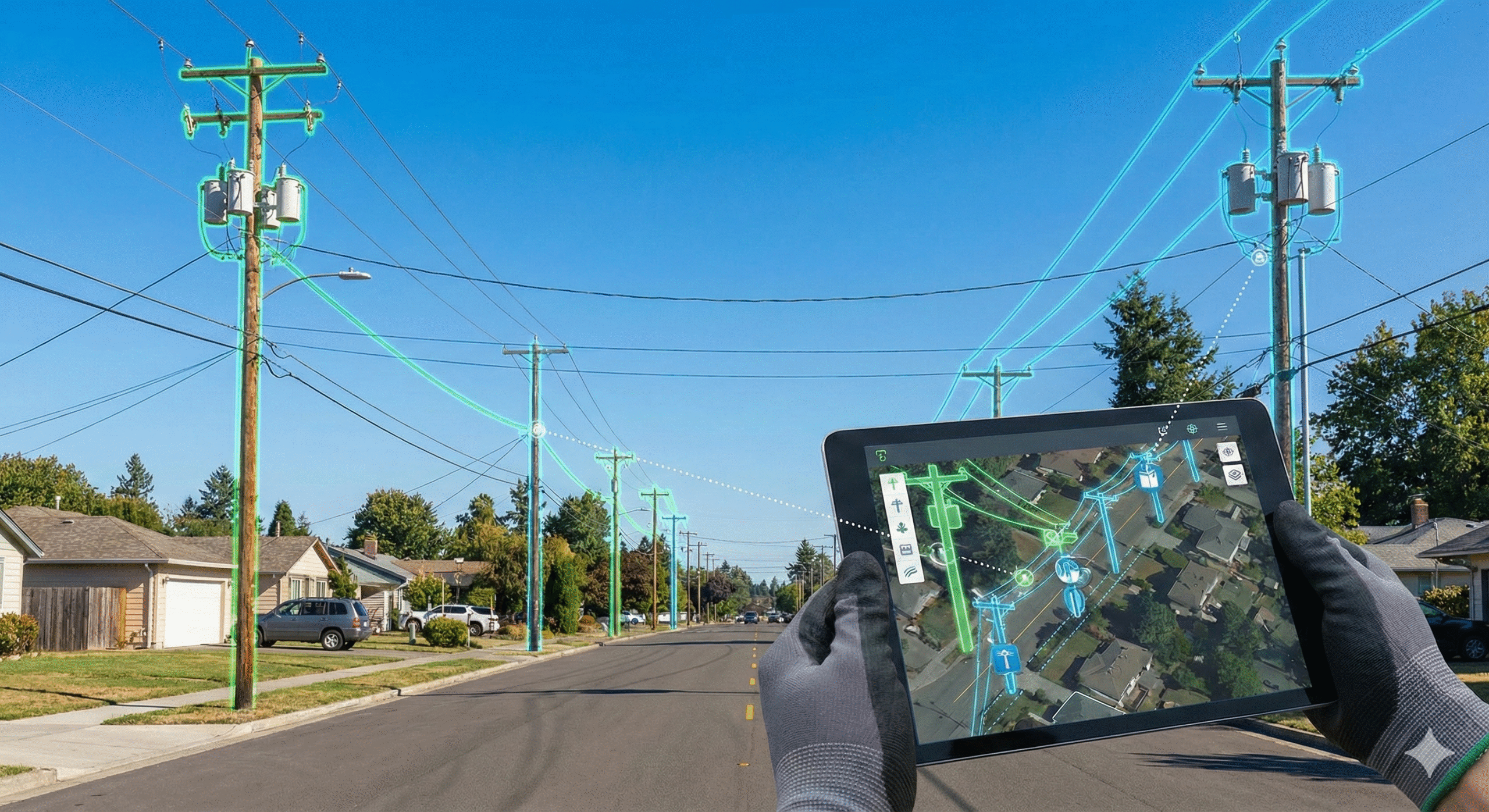
Every utility understands the importance of an accurate asset map. For power poles, transformers, attachments, conductors, and underground infrastructure, these records form the foundation for planning, operations, maintenance, and compliance.
But the problem is execution.
For decades, asset mapping has depended on boots-on-the-ground field collection. Crews drive routes, inspect assets, record attributes, and update systems manually. That approach works, but it’s expensive, slow, and never truly finished. By the time one inspection cycle ends, the system has already changed.
Industry studies suggest that a significant share of utility GIS data is outdated or inaccurate, sometimes approaching 30% of mapped assets. When location data can’t be trusted, crews spend valuable time verifying what should already be known before getting to their core work of line construction, maintenance, and repairs.
It’s not uncommon for field teams to lose 15% to 30% of their day searching for poles, transformers, or lines that don’t match the map. During an outage, that delay matters. Instead of moving directly to the repair, crews often have to locate the asset first, turning what should be a straightforward fix into a slower, more expensive search and discovery process.
Utilities now face a simple but uncomfortable reality: Traditional field collection can’t keep pace with the rate of change.
The Hidden Cost of Field-Based Inventories
Field collection has long been treated as a necessary cost of doing business. But at scale, its limitations become hard to ignore.
Crews are expensive to deploy and difficult to pull away from their primary responsibilities of new construction and maintenance/repairs. Inspections take time, especially across large or dense service territories. Data collection methods vary by contractor or team, creating inconsistencies that require cleanup later. And even after all that effort, inventories quickly grow stale as new assets are installed, switching is updated, or vegetation grows back.
In some cases, utilities are still working from incomplete paper maps or digital records, relying on periodic surveys to fill in the gaps. In others, digital systems exist but refresh cycles lag behind reality. The result is a map that’s always chasing the present, never quite catching up.
An Imagery-Led Alternative
Utilities are beginning to rethink how asset inventories are created and maintained by starting from a different place: imagery instead of inspection routes. Much of the physical infrastructure utilities care about is already visible from the street. Power poles, crossarms, transformers, and joint-use attachments appear clearly in street-level imagery captured at scale.
Using tools such as Google Maps Imagery Insights, utilities can leverage pole locations and related features that have been automatically extracted from Street View imagery. Those extracted assets can then be modeled, stored, and analyzed in data warehouses like BigQuery, where they become query-ready, auditable, and equipped for use in downstream workflows.
Instead of sending crews to all corners of the service territory by default, utilities can use imagery to establish a comprehensive baseline asset map, quickly and cost-effectively, and direct crews to focus on specific areas.
What Actually Changes Day to Day
The value of an imagery-driven approach shows up in practical, operational ways.
First, inventory happens faster. Large portions of a service territory can be mapped in weeks rather than months, without coordinating field schedules or shutting down lanes.
Second, costs drop. Field work becomes targeted instead of universal. Crews are dispatched to validate, refine, or address exceptions, not to rediscover what’s already visible.
Third, data consistency improves. Assets extracted through a single imagery pipeline follow the same schema and classification rules, reducing the cleanup burden that often follows manual collection.
And most importantly, the asset map becomes something utilities can realistically keep current. Imagery updates allow for refresh cycles that align more closely with how infrastructure actually evolves.
A Stronger Foundation for Everything Downstream
Asset maps are rarely the end goal — they’re the starting point. When inventories are accurate and current, utilities unlock a range of downstream benefits:
- More reliable planning and capital allocation.
- Better vegetation management and inspection prioritization.
- Improved joint-use visibility for coordination with communications and fiber providers.
- Stronger inputs for reliability modeling and outage response.
This is why imagery-led inventory is an operational upgrade. It creates a data foundation that other systems, such as analytics, AI models, and operational workflows, can finally trust.
Not a Replacement for Field Work
This approach doesn’t eliminate field inspections; it changes how they’re used. Imagery creates the baseline. Field work validates, refines, and resolves edge cases. Instead of blanket inspections across an entire territory, utilities can focus crews where accuracy matters most: complex electrical configurations, new construction, or high-risk assets.
That shift matters. It reduces wasted effort, shortens inspection cycles, and allows skilled field teams to spend more time on work that truly requires human judgment.
Why This Matters Now
Utilities are under pressure to do more with less. Customer expectations around reliability are rising. Regulatory scrutiny isn’t easing. Demand on the power grid and grid complexity continue to accelerate.
At the same time, many organizations are sitting on asset data that’s incomplete, outdated, or costly to maintain through traditional methods. Imagery-led inventory offers a way out of that cycle.
By using imagery to build and refresh asset maps, utilities can move faster, spend smarter, and create a stronger foundation for everything that follows.
Ready to get started? Contact us now.