


The latest thought leadership, news, events, and more from Woolpert Digital Innovations
The Hidden Tax of Waiting: How Manual Coordination Slows Modern Operations
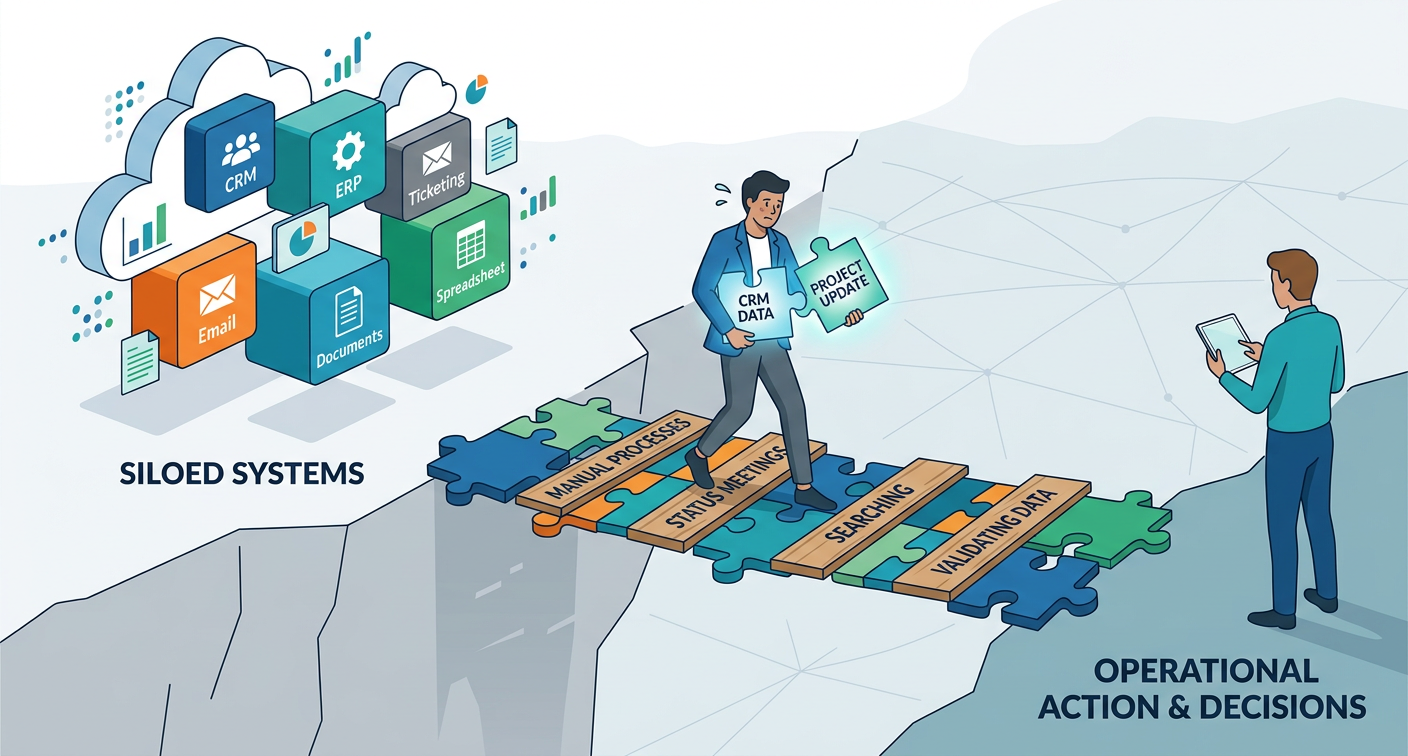
With the rise of enterprise AI tools, many organizations are now asking themselves if they have a data problem. The reality is that typically they don’t. What they have is a coordination problem — and AI can help solve that.
Information exists everywhere: Customer activity lives in CRM platforms and project status updates sit in ticketing systems. Companies of all sizes have financial data residing in various databases, and have conversations siloed away in email or chat platforms. Documents accumulate across shared drives and cloud storage.
Yet employees routinely spend a significant portion of their day searching for information, validating whether it’s current, and piecing together context from multiple systems before they make a decision.
The result is a form of operational friction that rarely appears on a balance sheet but affects nearly every part of the business. This hidden tax is the time and effort required to move information between systems, teams, and people. As organizations grow, that tax becomes increasingly expensive.
The Work Nobody Planned For
Most enterprise systems were purchased to solve a specific problem. A CRM helps manage customer relationships, for example, or a ticketing platform tracks projects. Maybe it’s an ERP that manages financial operations, or a collaboration platform that supports communication.
Individually, each system performs its intended function well. Collectively, they often create a new challenge: Employees become responsible for connecting them.
A project manager needs information from the CRM, the ticketing platform, email threads, and a spreadsheet before providing an update. An operations leader reviews reports from multiple systems to understand performance. Customer-facing teams spend time gathering information before responding to questions that should be straightforward.
None of this work is typically included in implementation plans, yet it becomes a permanent part of day-to-day operations. Organizations begin creating manual processes to bridge the gaps:
- Status meetings designed to synchronize information
- Reports assembled from multiple systems
- Email chains used to clarify missing context
- Spreadsheets that become unofficial systems of record
- Employees who serve as institutional translators between departments
The work feels necessary because it is necessary. The systems were never designed to operate as a unified environment.
How Decision Latency Takes Hold
The consequences extend beyond productivity. When information moves slowly, decisions move slowly.
Think about it: A customer issue takes longer to resolve because nobody has a complete view of the account. A project slips because updates are scattered across multiple platforms. A dispatch team spends valuable time validating information before acting on it. Leaders wait for reports that require manual assembly before they can evaluate performance.
Each delay appears minor in isolation, but collectively, they create what can be described as decision latency — the time between information becoming available and the organization acting on it.
For growing organizations, that delay compounds quickly: More customers create more interactions. More employees create more systems. More complexity creates more coordination. Without a way to connect information effectively, organizations often find themselves adding labor simply to keep information moving.
The irony is that many businesses have already invested heavily in technology designed to improve efficiency.
The challenge is that efficiency gains inside individual systems don’t automatically translate into efficiency across the business.
Why More Data Doesn’t Solve the Problem
The natural response is often to collect more information. In reality, most organizations already possess the data they need. The issue is accessibility and context. Traditional search tools can help locate documents. Dashboards can provide visibility into specific systems. Reporting tools can summarize historical activity.
But operational decisions rarely depend on a single source of information. Employees need context. They need to understand how customer activity relates to project status. How operational performance affects resource allocation. How multiple signals across different systems combine to create a complete picture of what’s happening.
Finding a file is not the same as understanding what action should happen next. This is why organizations are beginning to shift their focus from information storage toward operational intelligence.
The Rise of Connected Operational Systems
A growing number of organizations are exploring a different approach. Instead of asking employees to navigate system by system, they are creating operational layers that sit across existing platforms and bring information together in a single experience.
This is where solutions like Gemini Enterprise are gaining traction.
The value is not simply conversational search — it comes from the ability to connect information across systems that traditionally operate in isolation.
A user can ask:
- What projects are at risk this quarter?
- Which customer issues remain unresolved?
- What operational trends require attention?
- Where are delays affecting service performance?
The response is not limited to one platform. Information can be gathered from connected systems, synthesized, and presented in a format that supports action. This shift changes how employees interact with technology. Instead of spending time collecting context, they spend time evaluating and acting on it.
From Information Retrieval to Operational Action
The next phase is already emerging. Organizations are increasingly interested in workflows that move beyond retrieval and into execution. This is where agentic capabilities become relevant.
Rather than simply surfacing information, connected systems can help automate the actions that follow. Creating documentation, updating project records, generating reports, notifying stakeholders, and initiating workflows can all happen within the same operational environment.
The objective is to reduce the amount of manual coordination required before meaningful work can occur. For many organizations, the largest opportunity is in eliminating low-value effort that prevents skilled employees from focusing on higher-value decisions.
Why Organizational Speed Matters More Than Ever
Markets move faster than they did a decade ago. Customers expect quicker responses. Operations generate more data. Supply chains have become more dynamic. Business conditions change rapidly.
Organizations that can identify issues, understand context, and act quickly gain a meaningful advantage. The competitive difference increasingly comes down to responsiveness, because one company can move on a given piece of information faster.
Reducing decision latency improves customer service, operational efficiency, project execution, and resource allocation. It helps organizations respond to changing conditions without adding layers of coordination to every process. In many cases, the opportunity is already sitting inside the business.
The data exists. The systems exist.
The challenge is connecting them in a way that allows information to move as efficiently as the organization needs it to.
The Bigger Opportunity
For years, enterprise technology has focused on systems of record: places where information is stored, tracked, and managed.
A new category is emerging alongside them: systems of coordination.
These platforms help organizations understand what’s happening across the business, connect information from multiple sources, and reduce the manual effort required to move work forward.
For leaders evaluating AI, this may be one of the most practical opportunities available today. The goal is to remove the hidden tax of waiting.
When information moves faster, decisions happen sooner. When decisions happen sooner, organizations become more responsive. And when responsiveness improves, the benefits extend across every part of the business.
The most valuable AI initiatives may be the ones that eliminate the friction surrounding the work.
How much time does your organization spend moving information instead of acting on it?
If employees are routinely switching between systems to gather context, reconcile data, and coordinate decisions, there may be an opportunity to reduce operational friction. Woolpert Digital Innovations helps organizations identify high-friction workflows and evaluate how connected platforms like Gemini Enterprise can accelerate decision-making across the business.